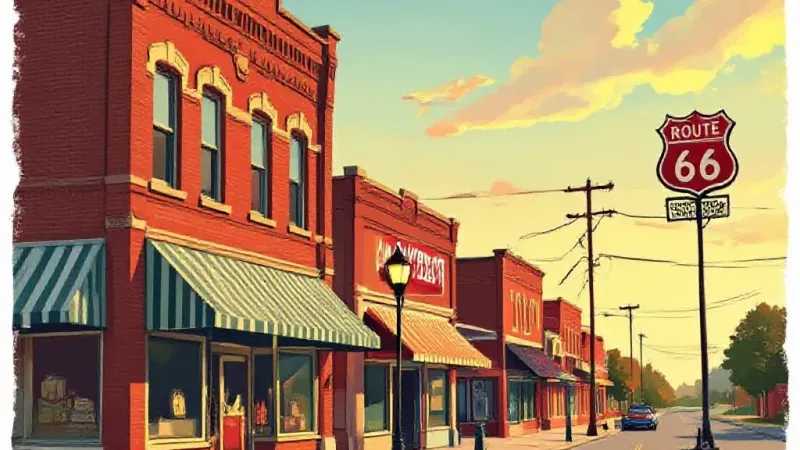
Neosho and the wider Southwest Missouri region have served as a foundation for individuals whose influence extended across the nation and beyond. Three such figures — artist Thomas Hart Benton, publishing pioneer Daniel Longwell, and agricultural scientist George Washington Carver — each hold significant, though distinct, connections to the area.
Thomas Hart Benton, a leading American artist of the 20th century, was born in Neosho, Missouri, on April 15, 1889. His father was a U.S. Congressman, and Benton spent part of his early life in Southwest Missouri before pursuing art training in Chicago and Paris. While his career traversed the country and overseas, his Missouri upbringing left a lasting impression, shaping the subjects and themes for which he became known. Benton was a central figure in the Regionalist movement, an artistic style that depicted everyday American life, particularly in rural and Midwestern communities. His murals and paintings, including *America Today* and works in the Missouri State Capitol, captured scenes of farmers, laborers, and small-town existence with energy and dignity. His regional connection helped imbue his work with an authenticity that resonated nationally, demonstrating how Southwest Missouri's culture influenced one of America's prominent artists.
Daniel Longwell, born in Omaha, Nebraska, in 1899, developed a meaningful connection to Neosho later in his life. Longwell became a key figure in American publishing as one of the founding editors of *Life* magazine. Under his leadership, the magazine pioneered modern photojournalism, merging powerful imagery with compelling storytelling and transforming the industry. After a distinguished career with Time Inc., Longwell retired to Neosho in 1954, returning to a farm linked to his earlier life. During his years in Neosho, he became actively involved in the community. Longwell is often credited with helping promote civic pride and beautification efforts, contributing to Neosho’s identity as the “Flower Box City.” He spent the remainder of his life in Neosho, passing away there in 1968, making the town a significant place in his life's narrative.
George Washington Carver was born in the early 1860s near Diamond, Missouri, a few miles from Neosho. While his birthplace is widely recognized, a crucial part of his early life unfolded in Neosho itself. As a young boy eager to learn, Carver traveled to Neosho to attend school. He enrolled in the Neosho Colored School, a one-room school established for African American students following the Civil War. Around 1876–1877, Carver studied there while living with the Watkins family. This period offered him one of his first opportunities for formal education, sparking a lifelong passion for learning and discovery. From these beginnings, Carver became one of American history’s most influential agricultural scientists. At the Tuskegee Institute, he developed innovative farming methods, advocated for crop rotation, and created hundreds of practical applications for crops such as peanuts, sweet potatoes, and soybeans. His work significantly improved soil health and sustainability for farmers, particularly across the rural South. His achievements were guided by a belief that knowledge should be used to improve the lives of others. Today, the George Washington Carver National Monument preserves his birthplace, and the story of his education in Neosho serves as a reminder of how opportunity can shape a future.
The stories of Benton, Longwell, and Carver illustrate how individuals with roots in or ties to Southwest Missouri achieved national recognition. Some were born in the area, some were shaped by it, and some chose to return. Their journeys reflect the region's character—a place where determination is formed, creativity is nurtured, and lives take shape in ways that extend far beyond local boundaries, leaving a lasting impact on history.